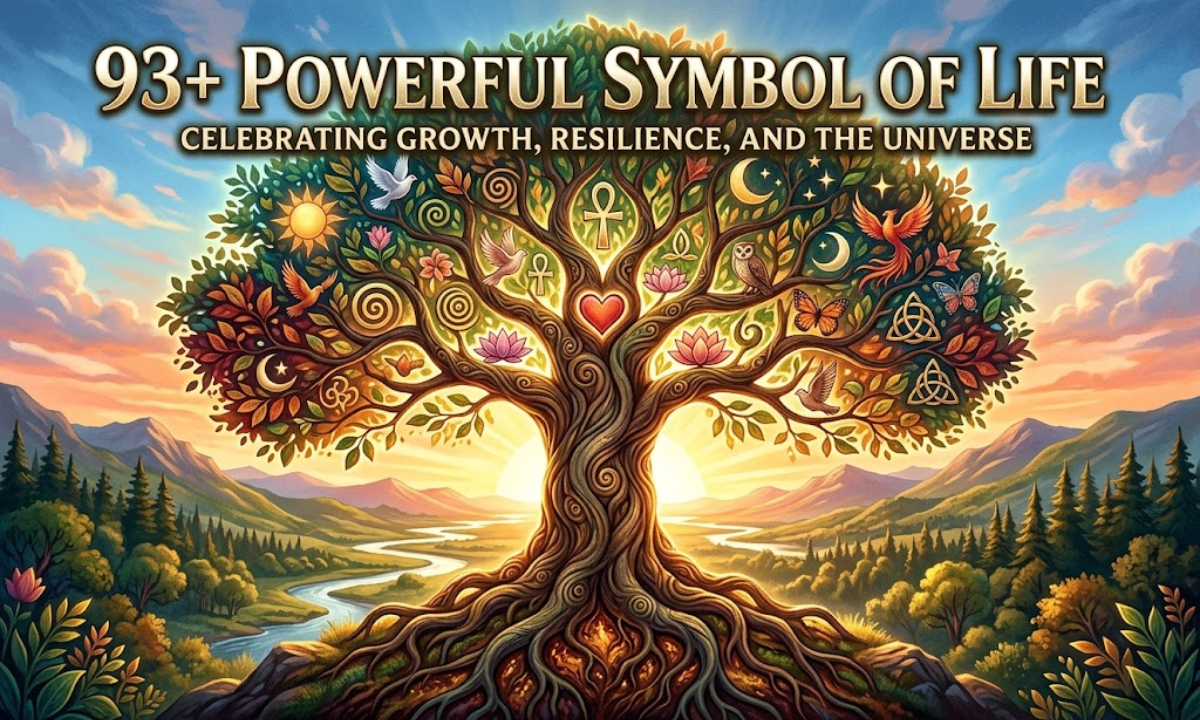
Every culture in human history has reached for the same question: how do you picture something as vast as life itself? The answer usually isn’t a sentence. These are symbol of life. A tree, a circle, a serpent curled into a loop. These images carry meaning that words often can’t hold on their own.
This guide walks through 93+ symbol of life, where they come from, and why they still shape how people express identity, faith, and hope today.
What Are Life Symbols?
Life symbols are images, marks, or objects used to represent existence, vitality, growth, or the continuation of the human spirit. They compress big ideas, birth, death, eternity, transformation, into a single visual that anyone can recognize, even across language barriers.
These symbols generally fall into three broad groups:
- Natural symbols – sun, water, trees, seeds, fire
- Animal symbols – phoenix, scarab, butterfly, serpent
- Geometric symbols – circle, spiral, infinity sign, sacred patterns
Life Symbols and Meanings: A Master Overview
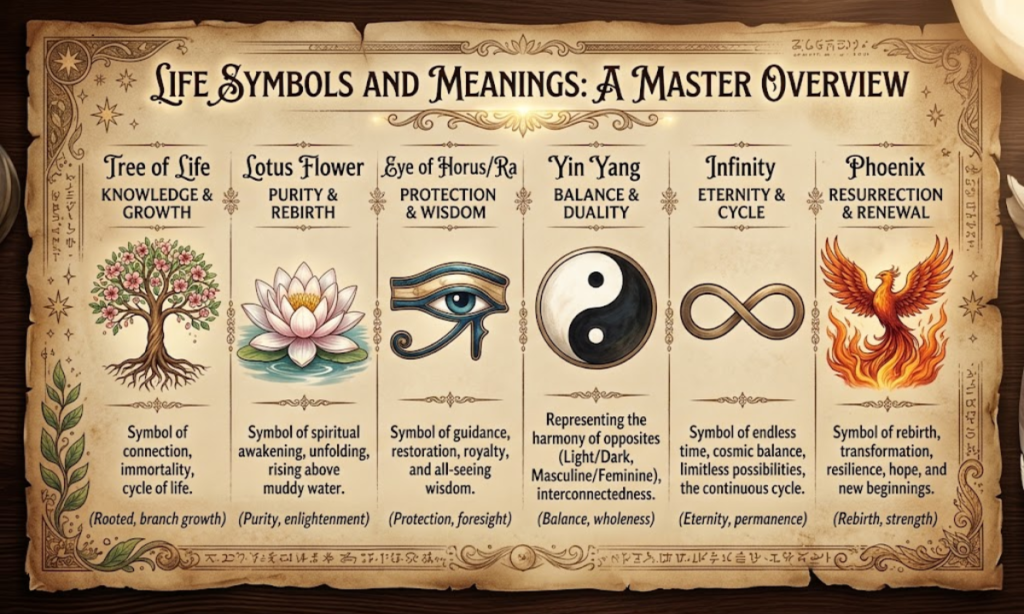
Before diving into specific traditions, it helps to see the bigger picture. Different cultures often arrived at strikingly similar symbols independently, which suggests these images speak to something universal in human experience.
| Symbol | Origin | Core Meaning |
| Ankh | Ancient Egypt | Eternal life, divine power |
| Tree of Life | Multiple cultures | Growth, connection, rebirth |
| Ouroboros | Egypt / Greece | Endless cycles, renewal |
| Infinity Symbol | Modern / mathematical | Continuity, unending connection |
| Lotus Flower | Buddhism / Hinduism | Enlightenment, rising above hardship |
| Phoenix | Greek mythology | Death and rebirth |
| Scarab | Ancient Egypt | Transformation, renewal |
| Yin-Yang | Taoism | Balance between opposing forces |
Tree of Life Symbols and Meanings
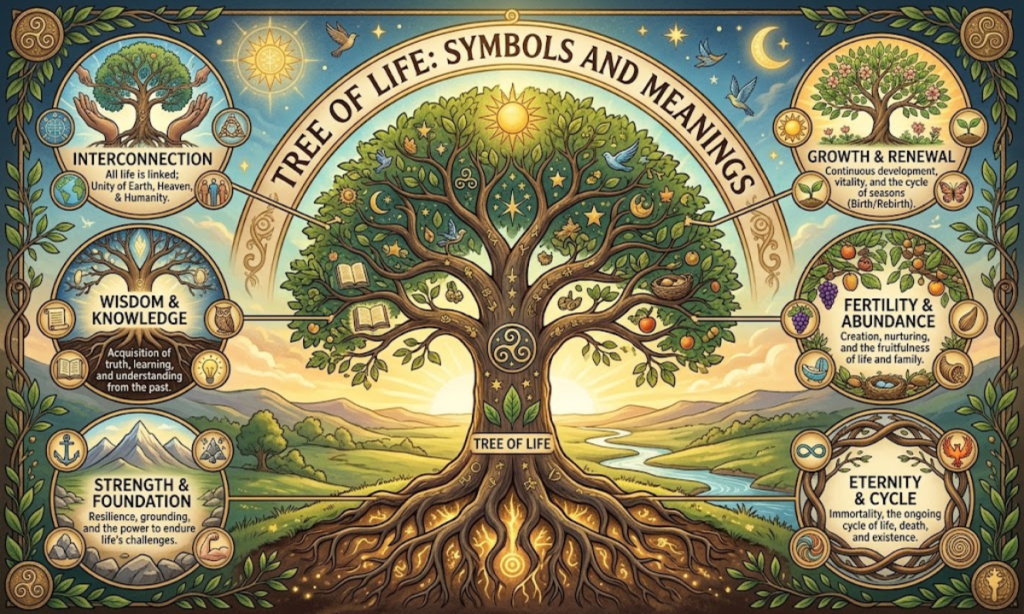
The Tree of Life symbolizes growth, strength, connection between heaven and earth, and the eternal cycle of birth, death, and rebirth, and it appears in nearly every major world culture.
At its core, the symbol of life represents growth and strength, much like a tree growing stronger through years of weathering storms, as well as ancestry and family, since branches represent new generations while roots connect people to their past. This is part of why the image remains so popular in personalized jewelry, particularly for gifts honoring mothers and grandmothers as the “root” of the family.
Eternal Life Symbols
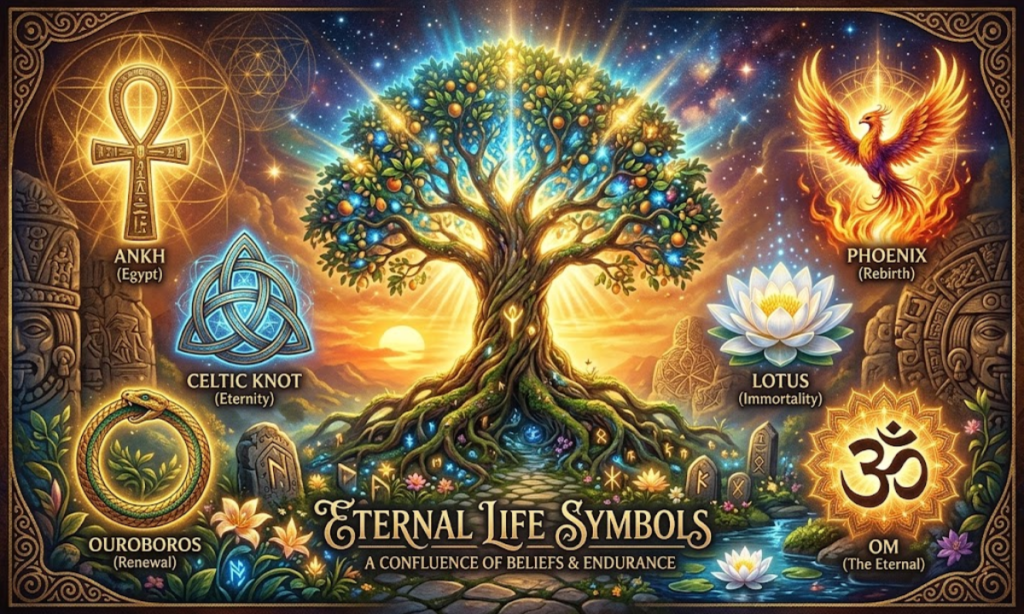
Certain images appear again and again whenever a culture wants to express the idea that existence doesn’t truly end, it transforms.
The Ankh
The ankh, or key of life, is an ancient Egyptian hieroglyphic symbol used to represent the word for “life” and, by extension, life itself. It has a T-shape topped by a droplet-shaped loop and often appears in the hands of deities, sometimes being given to the pharaoh to represent their power to sustain life.
The Ouroboros
The Ouroboros, a serpent or dragon eating its own tail, is one of the oldest symbols in recorded history, appearing in ancient Egypt and Greek alchemy. It represents a loop with no true beginning or end, making it a lasting metaphor for eternal life and self-renewal.
The Infinity Symbol (∞)
The infinity symbol, along with the circle, represents cycles with no beginning and no end</cite>. Unlike ancient religious emblems, this symbol has become a modern, secular shorthand for endless love and unbroken connection.
Egyptian Life Symbols
Ancient Egypt produced some of the most enduring life symbols in history, many of which still appear in jewelry and tattoo art today.
The Ankh
Known as the “Key of Life” or “Cross of Life,” the Ankh represents eternal life, immortality, and the union of opposites, life and death, male and female. Many Egyptians wore it as an amulet for protection, and tombs often contained ankhs to ensure the deceased’s journey into eternal life.
The Scarab Beetle
The scarab represented rebirth and transformation, inspired by the way dung beetles roll their eggs into balls, an image ancient Egyptians connected to the sun god rolling the sun across the sky each day. Scarab amulets were commonly placed with the dead to symbolize renewal in the afterlife.
The Djed Pillar
<cite index=”28-1″>The Djed column represents stability and fortitude, closely associated with Osiris, god of the underworld and fertility, and it has been suggested the column represents a stylized tree</cite>. It was often paired with the Ankh to combine stability with life force.
The Eye of Horus
<cite index=”40-1″>The Wadjet, also known as the Eye of Horus or the all-seeing eye, is a powerful symbol of protection in ancient Egypt, intended to protect the pharaoh in life and the afterlife and to ward off evil</cite>. Sailors even painted it on ships to ensure safe travel.
Spiritual Life Symbols and Meanings
Spiritual traditions across the world use imagery to express awakening, balance, and the movement of life energy.
Lotus Flower
<cite index=”40-1″>The lotus is an important spiritual symbol in Buddhism and several other religions, generally seen as a sign of enlightenment</cite>. <cite index=”40-1″>The flower grows out of dark, muddy water to open its petals toward sunlight, representing a journey out of darkness</cite> and into spiritual clarity.
The Spiral
The spiral represents constant motion and growth rather than a fixed state. Found in shells, galaxies, and plant stems, it reflects how life rarely moves in straight lines, instead expanding outward in cycles.
The Infinity Symbol
Beyond its mathematical origin, the infinity symbol of life has become a personal spiritual emblem representing limitless potential, unity, and a life without boundaries.
New Life Symbols
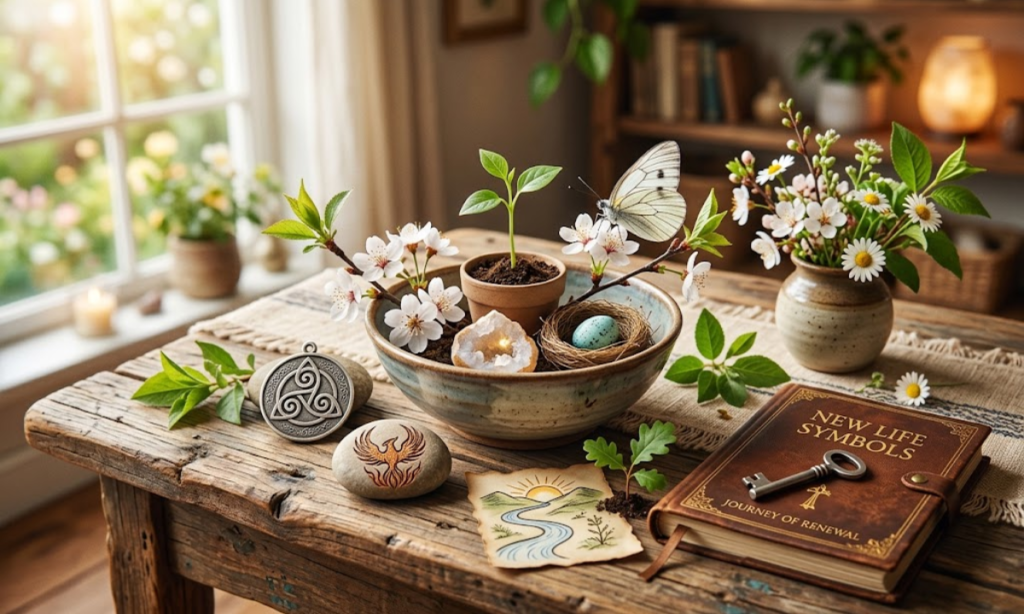
Not every meaningful symbol of life is ancient. Modern life has produced its own visual shorthand for vitality and continuation:
- DNA double helix – the scientific blueprint of all living things
- Heartbeat (EKG) line – a direct, modern symbol of active life
- Seedling icon – used widely in branding to represent fresh starts
- Rising sun graphic – common in wellness and recovery communities
- Butterfly emoji/tattoo – personal transformation and new beginnings
Greek Life Symbols and Meanings
Greek mythology and culture contributed several enduring emblems tied to peace, wisdom, and the cycle of life.
The Olive Branch
<cite index=”36-1″>The Olive Branch is deeply tied to the goddess Athena, who gifted the olive tree to Athens, and it represents peace, new life, prosperity, and hope</cite>. <cite index=”36-1″>Today it remains an international symbol of peace, used by the United Nations</cite>.
The Greek Key (Meander)
<cite index=”36-1″>This interlocking geometric pattern found on ancient Greek pottery represents eternity and the continuous flow of life, with its unbroken, repeating pattern symbolizing infinity and interconnectedness</cite>.
The Owl
<cite index=”36-1″>Sacred to Athena, the Owl symbolizes wisdom, insight, and the ability to see beyond illusion, qualities central to living a meaningful, examined life</cite>.
The Ankh-Style Cross Confusion
<cite index=”36-1″>Some people confuse the Ankh with early Christian cross symbols adapted by Greek Coptic Christians, known as the “crux ansata,” and while visually similar, the two carry distinct meanings rooted in their separate traditions</cite>.
Flower of Life Symbol
The Flower of Life is a sacred geometric pattern made of overlapping circles arranged in a flower-like design. It’s considered one of the oldest known sacred geometry symbols, representing creation, unity, and the interconnected structure of all living things. Many spiritual practitioners use it in meditation as a visual reminder of how individual life connects to a larger whole.
Life Symbols Across Cultures
The same core ideas, growth, renewal, connection, appear again and again, shaped differently by each culture’s worldview.
Ancient Egypt
<cite index=”38-1″>Egyptian symbols like the Ankh and Eye of Horus served as a bridge between the earthly and the divine</cite>, appearing in tombs, temples, and royal iconography to represent eternal life and protection.
Celtic Culture
<cite index=”32-1″>The Celts celebrated the Tree of Life, the Spiral, and the Triquetra, three interlocking arcs representing life, death, and rebirth</cite>, reflecting a belief that nature itself was sacred and alive with meaning.
Eastern Cultures
<cite index=”32-1″>In Hinduism and Buddhism, the Lotus Flower, the Mandala, and the Om symbol represent spiritual life, enlightenment, and the eternal nature of the soul</cite>.
Greek Mythology
<cite index=”32-1″>Greek culture contributed the Olive Branch, the Owl, and mythological creatures like the Phoenix to the global language of life symbols</cite>.
Native American Culture
<cite index=”32-1″>The Medicine Wheel and the Labyrinth, also called the “life maze,” represent life’s journey and the cycles of existence</cite>, reflecting a worldview where life moves through repeating stages rather than a single straight path.
Life Symbols in Art, Movies and Pop Culture
Movies
Filmmakers frequently lean on life symbols visually rather than through dialogue, an Ouroboros tattoo hinting at a character’s fate, a tree representing a family’s roots, or a phoenix rising to signal a comeback arc.
Paintings
From Renaissance religious works featuring the Tree of Life to modern abstract art built entirely around spirals and circles, painters have long used these symbols as shorthand for themes too large to state directly.
Tattoos
<cite index=”32-1″>Tree of Life tattoos and Infinity symbol tattoos rank among the most requested tattoo designs globally, chosen to carry life’s meaning permanently on the skin</cite>.
Fashion and Jewelry
<cite index=”32-1″>Ankh pendants, infinity bracelets, and lotus earrings are popular worldwide, worn as personal talismans for daily life</cite>. <cite index=”25-1″>Family Tree necklaces often feature birthstones on the branches representing each family member, making them a popular and meaningful gift choice</cite>.
Positive and Negative Meaning of Life Symbols
Positive Meaning
Most life symbols are used to express hope, resilience, growth, and connection. The Lotus represents rising above hardship, the Phoenix represents recovery, and the Tree of Life represents family bonds that endure over generations.
Negative Meaning
Context can shift a symbol’s meaning. The Ouroboros, for instance, can be read as an endless, inescapable cycle rather than renewal, and spirals can represent being trapped in repeating patterns rather than growth. Meaning always depends on the story surrounding the image.
Deep Symbolic Meaning of Life Symbols
Spiritual Meaning
Spiritually, these symbols often act as a bridge between the physical and the divine. <cite index=”27-1″>The Ankh represents the union of opposites, male and female, earth and sky, life and afterlife</cite>, a theme echoed in nearly every eternal life symbol across cultures.
Psychological Meaning
<cite index=”32-1″>Psychologists like Carl Jung believed that symbols are the language of the unconscious mind</cite>, which may explain why certain shapes, a tree, a circle, a spiral, feel emotionally significant even without knowing their formal history.
Cultural Meaning
<cite index=”29-1″>These symbols offer deep interpretive insights into the spiritual and philosophical perspectives of different cultures, functioning as rich, narrative emblems that transcend time</cite>.
Why Humans Are Attracted to Life Symbols?
People are drawn to life symbols because they offer a way to hold onto something enormous, existence itself, in a form that fits on a necklace, a canvas, or skin. A symbol doesn’t require translation. It communicates instantly, across generations and languages, at moments that matter most: births, weddings, funerals, and personal turning points.
<cite index=”33-1″>Throughout history, symbols representing life have been used in funerals, births, weddings, and spiritual ceremonies, confirming that humans instinctively turn to visual symbols during major life transitions</cite>. That instinct hasn’t faded. If anything, in a world full of noise, a single, timeless image can say more than paragraphs ever could.
FAQs
What is the most powerful symbol of life?
The Ankh is widely regarded as the most powerful and recognizable symbol of life, representing eternal existence in ancient Egyptian culture.
What does the Tree of Life represent?
It represents growth, family connection, and the continuous cycle of birth, death, and rebirth.
What symbol represents eternal life?
The Ankh, the Ouroboros, and the infinity symbol are the most common symbols tied to eternal life.
What flower symbolizes life and renewal?
The Lotus flower is the most widely recognized symbol of spiritual awakening and renewal.
What is the Flower of Life symbol?
It’s a sacred geometric pattern of overlapping circles representing creation, unity, and interconnected existence.
Can life symbols have negative meanings?
Yes, context matters; symbols like the Ouroboros or spiral can represent being trapped in a cycle rather than renewal.
Why do people get life symbol tattoos?
Because these symbols carry deep personal meaning, growth, family, resilience, in a permanent, easily recognizable form.

I’m Hannah Grace, a content writer and language enthusiast focused on explaining texting abbreviations, slang, internet terms, and modern expressions. I create clear, accurate, and easy-to-understand content to help readers discover the meaning behind words and phrases used in everyday conversations.